Baking Pantry Essentials: What to Keep on Hand
The pantry essentials for baking are all-purpose flour, granulated and brown sugar, baking soda, baking powder, salt, vanilla, butter, eggs and milk. With those you can make cookies, muffins, pancakes, quick breads and simple cakes. Add yeast, chocolate, a few spices and some extras when you bake often or the holidays are coming.
The short version: buy the starter set below first. White flour and sugar keep for many months, but baking powder, yeast and whole wheat flour fade faster, so buy those in sizes you'll finish. Store everything airtight, cool and dry. Test baking soda, baking powder and yeast before a big baking day; each test takes a few minutes.
This list is about baking. For the everyday staples (rice, cans, oils, spices for cooking), see our pantry staples list.
Starter set vs holiday baker set
You don't need a specialty shop's worth of ingredients to start. Here's how the two tiers compare.
| Category | Starter set | Holiday baker adds |
|---|---|---|
| Flour | All-purpose | Bread, whole wheat, cake flour |
| Sugar | Granulated, light brown | Powdered, dark brown, molasses |
| Leaveners | Baking soda, baking powder | Dry yeast, cream of tartar |
| Fats | Butter, neutral oil | Shortening, extra butter in the freezer |
| Dairy and eggs | Eggs, milk | Heavy cream, buttermilk, cream cheese |
| Flavor | Salt, vanilla, cinnamon | Nutmeg, ginger, cloves, almond extract |
| Add-ins | Chocolate chips | Nuts, dried fruit, cocoa, coconut |
Start with the first column. Add from the second when a recipe you want to make calls for it, rather than all at once.
The baking essentials list, by category
Flours
- All-purpose flour. Handles cookies, cakes, pie crust, pancakes and most quick breads.
- Bread flour. Higher protein, for chewier yeast breads and pizza. Optional.
- Whole wheat flour. Adds flavor and fiber. Buy small bags, since it goes stale much faster than white flour (more on that below).
- Cornstarch. Thickens pie fillings and puddings, and softens some cookies and cakes.
- Cake flour. Only if you make a lot of layer cakes.
Sugars and sweeteners
- Granulated sugar. The default in most recipes.
- Light brown sugar. For chocolate chip cookies, crumbles and anything that should taste a little caramel.
- Powdered sugar. For frosting, glazes and dusting.
- Dark brown sugar, molasses and honey. Gingerbread, spice cookies and some breads.
Leaveners
- Baking soda. Needs an acid in the recipe (buttermilk, brown sugar, yogurt, lemon) to work.
- Baking powder. Has its own acid built in, so it works in recipes without one.
- Dry yeast. Active dry or instant, for bread, rolls and cinnamon buns.
- Cream of tartar. Steadies egg whites for meringue. Holiday tier.
Fats
- Unsalted butter. Many recipes are written for unsalted, so you control the salt.
- Neutral oil (vegetable or canola). For muffins, brownies and oil cakes.
- Vegetable shortening. Optional, for flaky pie crust.
- Nonstick spray or parchment paper. For pans.
Eggs and dairy
- Large eggs. Most recipes are written for large.
- Milk.
- Heavy cream, buttermilk, sour cream, cream cheese. Holiday tier, or buy them for a specific recipe.
- Evaporated or sweetened condensed milk. Shelf-stable cans for pumpkin pie, fudge and bars.
Flavorings and spices
- Salt.
- Pure vanilla extract.
- Ground cinnamon.
- Holiday spices: nutmeg, ginger, cloves, allspice.
- Other extracts: almond, peppermint, lemon. Small bottles go a long way.
Add-ins
- Chocolate chips, semi-sweet to start.
- Unsweetened cocoa powder.
- Baking chocolate bars, for melting.
- Nuts: walnuts, pecans or almonds.
- Dried fruit: raisins or dried cranberries.
- Shredded coconut and rolled oats.
Tools
Ingredients only help if you can measure and bake them. A basic kit:
- Starter: measuring cups and spoons, a mixing bowl or two, a whisk and a spatula, a baking sheet, a 9 x 13 inch pan, a loaf pan, a muffin tin and a cooling rack.
- Holiday baker adds: a kitchen scale, a hand or stand mixer, a rolling pin, a pie plate, round cake pans, cookie cutters and an oven thermometer.
How long baking ingredients keep
Most of these times come from the data behind the USDA's FoodKeeper app. "Unopened" counts from the day you buy it; the times are for best quality, not a safety cutoff.
| Ingredient | Unopened | After opening |
|---|---|---|
| White flour | 6 to 12 months | 6 to 8 months (1 year in the fridge) |
| Whole wheat flour | 3 to 6 months | 6 to 8 months in the fridge |
| Sugar (white, brown, powdered) | Indefinitely | Best within 18 to 24 months |
| Baking soda | 2 to 3 years | 6 months |
| Baking powder | 6 to 18 months | 3 to 6 months |
| Dry yeast | About 2 years | Up to 4 months, cold |
| Cornstarch | 18 to 24 months | 18 months |
| Shortening | 1 to 2 years | 6 to 12 months |
| Baking chocolate | 1 to 2 years | 1 year |
| Cocoa powder | Not listed | 1 year |
| Nuts in jars or cans | 1 year | 2 to 9 months (4 to 6 in the fridge) |
| Dried fruit | 6 months | 1 month (6 in the fridge) |
| Evaporated or condensed milk | 1 year | 4 to 5 days in the fridge |
| Ground spices | 2 to 3 years | 2 to 3 years |
The yeast times come from the yeast makers: Fleischmann's says sealed dry yeast lasts around two years and opened jars keep up to four months in the fridge, and Red Star says to use an opened jar within 4 months, kept in the fridge or (preferably) the freezer. In the fridge, the FoodKeeper gives butter 1 to 2 months (6 to 9 in the freezer). Eggs in the shell keep 3 to 5 weeks according to the USDA's egg storage chart, and the FDA suggests using them within 3 weeks for best quality.
Two things stand out. Of the leaveners, baking powder has the shortest window once opened, so a big tin is rarely a bargain. And whole wheat flour is the one flour worth keeping cold.
For the rest of your kitchen, including the fridge and freezer, our food expiration dates chart has the full list. If the date on a package confuses you, see Best By vs Use By vs Sell By.
How to store baking ingredients
Flour: airtight, cool and dark. King Arthur points out that paper flour bags don't protect well against moisture and heat, and recommends moving flour into an airtight container or bag. Tape the best-by date from the bag to the container so you still know it.
Whole wheat and nut flours: the freezer. Their natural oils start to oxidize after milling, so King Arthur suggests freezing them if you won't finish them before the best-by date. You'll know they've turned because, in King Arthur's words, "the oils become rancid and smell a bit like Play-Doh." King Arthur also notes that four days in the freezer kills any pests that came home in a bag of flour.
Sugar: sealed tight. Sugar doesn't spoil, but it does pick up moisture. Keep brown sugar in an airtight container or a well-closed bag so it stays soft.
Baking soda and baking powder: closed and dry. Both react with moisture, so keep lids on and keep them away from the stove and the kettle. Write the date you opened them on the lid.
Yeast: in the fridge or freezer once open. Fold the packet closed or use the jar, and keep it cold, as the makers advise above.
Butter and eggs: in the fridge. The FDA says to keep eggs in their original carton in a refrigerator at 40°F (4°C) or below. Butter keeps 1 to 2 months in the fridge and 6 to 9 months in the freezer, so a holiday stash can go in the freezer weeks ahead.
Nuts and dried fruit: cold once opened. The FoodKeeper gives opened dried fruit about a month in the pantry but 6 months in the fridge, and opened nuts last longer cold too.
Keep baking together. One shelf or bin for all of it lets you see what's running low before you start a recipe. Our guide on how to organize your pantry by category covers zones and labels.
How to tell if baking soda, baking powder and yeast still work
Leaveners lose strength gradually, and a tired one gives you flat cookies and dense bread even when it looks fine. These quick tests from King Arthur and the yeast makers settle it.
Baking soda
- Put 1 tablespoon of vinegar in a small bowl.
- Stir in 1/2 teaspoon of baking soda.
- It should fizz right away, and hard. A weak or slow fizz means it's time for a new box.
Baking powder
- Put 2 tablespoons of warm water in a bowl.
- Stir in 1/2 teaspoon of baking powder.
- It should clearly bubble and foam. Expect a gentler reaction than baking soda gives, but if little happens, replace it.
Dry yeast
- Pour 1/4 cup of lukewarm water, 100 to 110°F (38 to 43°C), into a cup.
- Sprinkle the yeast over it and stir to dissolve, then stir in 1 teaspoon of sugar.
- Wait 10 minutes. Fleischmann's says active yeast will bubble or foam and double in size.
If your yeast passes, you can add the mixture to your dough. King Arthur suggests cutting the recipe's liquid by the amount of water you used to test it. If it doesn't foam, toss it.
A good habit: test all three a week or two before your biggest baking day of the year, so you have time to restock.
Keeping your baking pantry stocked
The hard part isn't the list. It's knowing you're on your last bag of flour before you start a double batch of cookies, and remembering that the baking powder you opened last spring is past its best. Two habits help:
- Pick a low point for your big three. For most kitchens that's flour, sugar and butter. Decide when each one goes on the list: "one bag of flour left", "one pound of butter left".
- Note the date you open a leavener. Baking powder, baking soda and yeast all have short opened windows, so the opening date matters more than the date you bought them.
If you tend to buy a second bag of sugar "just in case", our tips on how to stop overbuying groceries can help.
How to do this in Panzy
Panzy is a pantry inventory app for iPhone, and it's a natural fit for a baking shelf: a handful of ingredients you use in bursts and don't want to run out of mid-recipe.
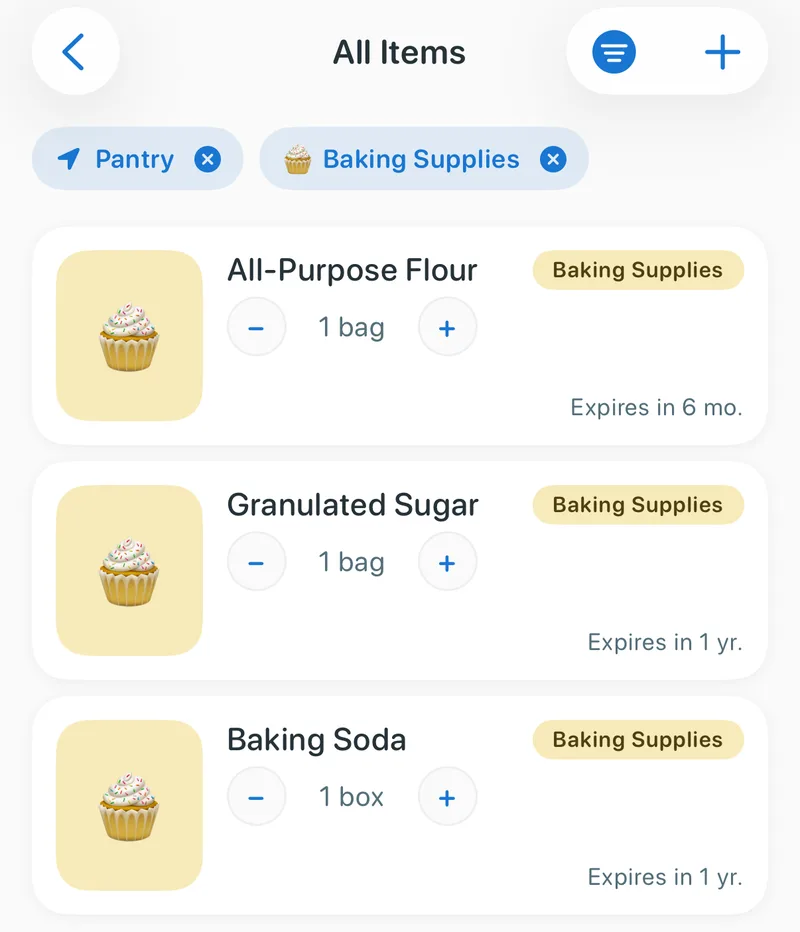
- Add your baking ingredients. Scan the barcode to fill in the details, then set the quantity, a unit like bag, box or stick, and the Baking Supplies category. Filter your items by the Pantry location and Baking Supplies to see your whole baking shelf from the store.
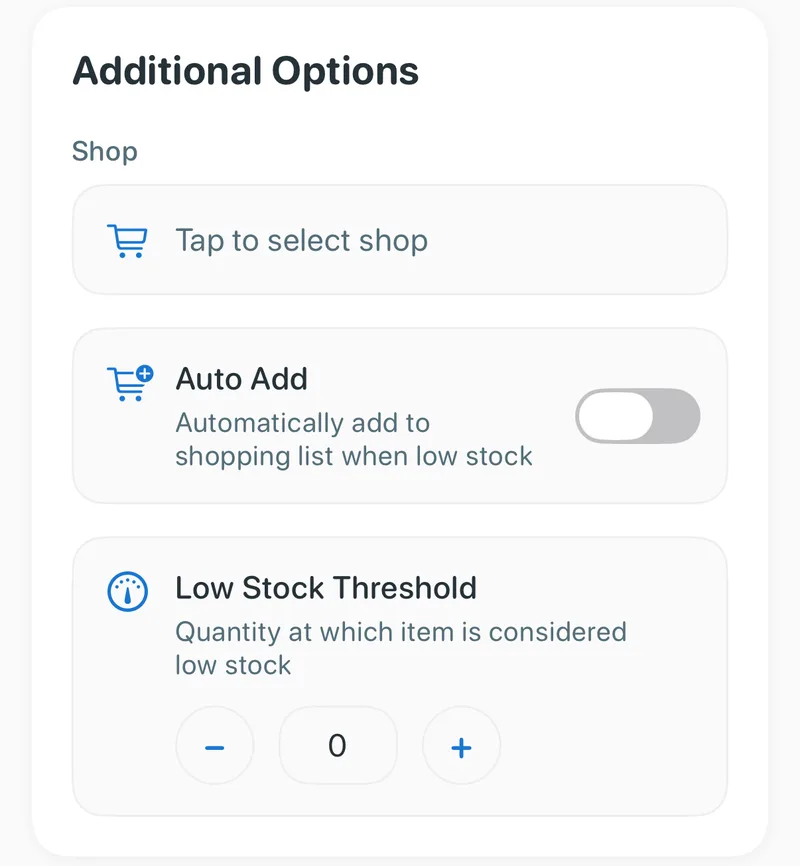
- Set low-stock levels for flour, sugar and butter. Each item has its own Low Stock Threshold. Set flour to 1 bag and butter to 2 sticks, and Panzy flags them as Low Stock as soon as you reach that amount.
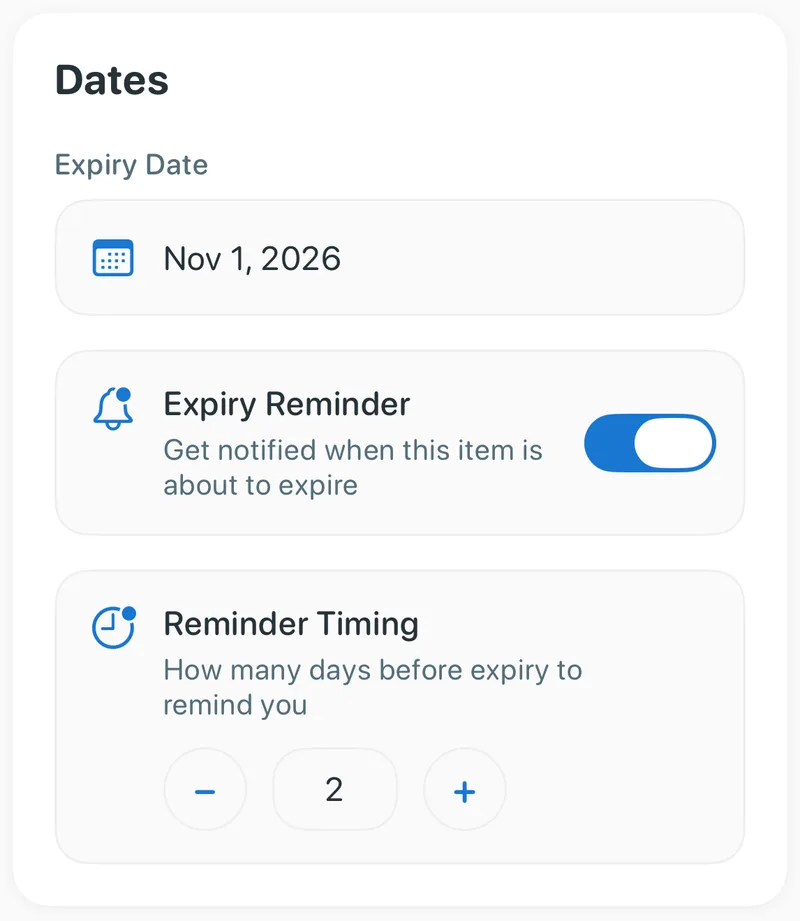
- Get an expiration reminder (Panzy+). Set an expiry date on baking powder or yeast and turn on Expiry Reminder, then choose how many days before the date you want the notification.
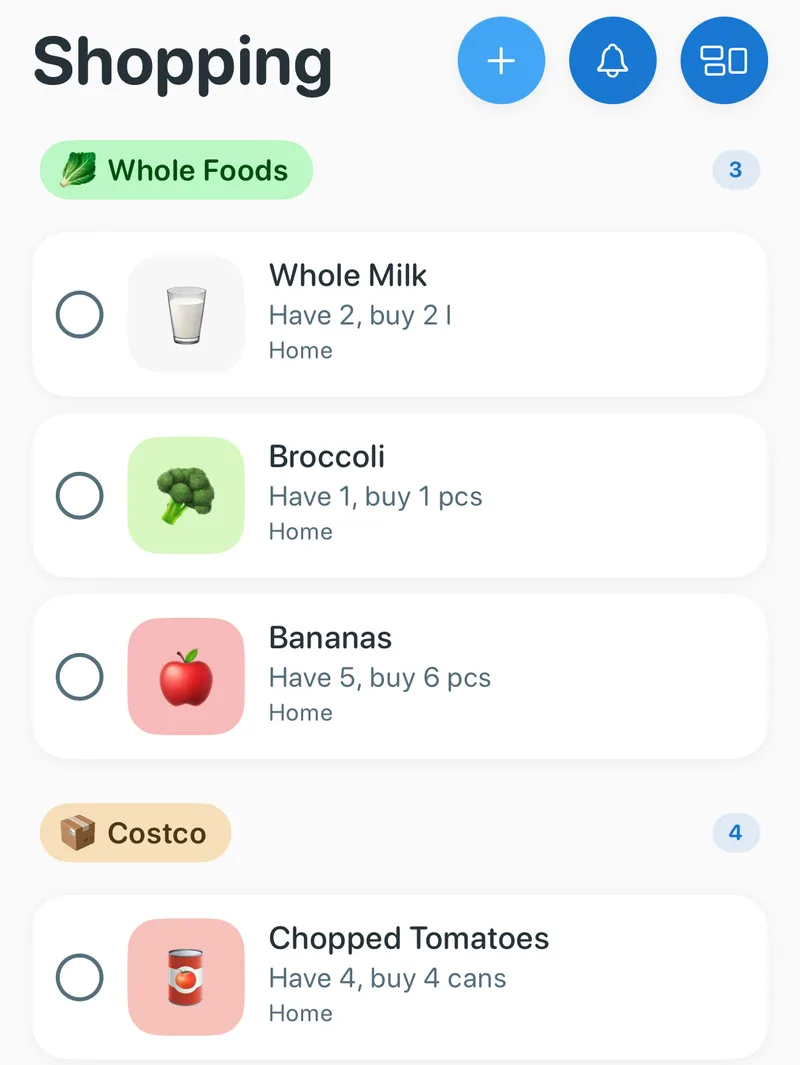
- Shop by shop. Save your shops and group the shopping list by shop, so the baking aisle run and the bulk store run each get their own section. With Panzy+, items set to Auto Add go onto the list by themselves when they run low.
The free version covers up to 50 items and 3 shops, with ads, which fits a full baking shelf with room to spare. Panzy+ adds unlimited items and shops, expiration reminders, the automatic shopping list, iCloud sync across your Apple devices, and no ads.

Panzy: pantry tracker
Track what's in your pantry, fridge and freezer, see what is expiring soon, and keep a shopping list that knows what you're low on. Free for up to 50 items.

Common questions
What are the most important baking ingredients to have?
All-purpose flour, granulated sugar, brown sugar, baking soda, baking powder, salt, vanilla, butter, eggs and milk. Those cover most cookies, muffins, pancakes, quick breads and simple cakes.
Does flour go bad?
Yes, slowly. The USDA's FoodKeeper gives white flour 6 to 12 months unopened in the pantry and whole wheat flour 3 to 6 months. Whole wheat goes stale first because of its oils; a sour or Play-Doh smell means it's time to replace it.
How long does baking powder last after opening?
The FoodKeeper gives opened baking powder 3 to 6 months. If yours has been open a while, test it with warm water before an important bake.
Can I use baking soda instead of baking powder?
Not as a simple swap. Baking soda needs an acid in the recipe to react, and baking powder brings its own, so swapping one for the other changes both the rise and the taste. It's easier to keep both on hand.