Thanksgiving Grocery List: Check Your Pantry Before You Shop
A classic Thanksgiving grocery list comes down to a turkey, fresh vegetables and herbs, butter, cream and eggs, bread for stuffing, a few cans, and baking and spice staples you may already own. The full list is below, grouped by store section so you can walk the store once. For the turkey, the USDA says to allow 1 pound per person.
The short version: buy 1 pound of turkey per person and plan at least 1/2 cup of stuffing each. Before you shop, check your spices, flour, sugar, broth and butter, because those are the things people rebuy by mistake. Buy shelf-stable and frozen food up to two weeks ahead, start thawing a frozen turkey the weekend before, and leave a fresh turkey and delicate vegetables for Tuesday or Wednesday.
How much turkey and stuffing to buy
Two amounts on a Thanksgiving list have an official answer, both from the USDA Food Safety and Inspection Service (FSIS):
- Turkey: Let's Talk Turkey says to allow 1 pound of whole turkey per person, fresh or frozen. For a frozen pre-stuffed turkey, allow 1¼ pounds.
- Stuffing: Stuffing and Food Safety says to plan at least 1/2 cup per person when it's baked in a casserole dish, which is how the USDA recommends cooking it.
The thawing time matters as much as the weight, since it decides when the turkey has to be in your fridge. FSIS allows about 24 hours in the fridge for every 4 to 5 pounds.
| Guests | Turkey | Stuffing | Fridge thaw |
|---|---|---|---|
| 8 | 8 lb | 4 cups | 1 to 3 days |
| 12 | 12 lb | 6 cups | 3 days |
| 16 | 16 lb | 8 cups | 4 days |
| 20 | 20 lb | 10 cups | 5 days |
| 24 | 24 lb | 12 cups | 6 days |
The turkey and stuffing columns are the USDA minimums, so go a few pounds bigger if you want leftovers for sandwiches and soup. For everything else on the list, like potatoes, green beans and pie, take the amounts from the recipes you're cooking and scale them to your guest count.
The Thanksgiving grocery list, by store section
This covers a classic menu: roast turkey with gravy, stuffing, mashed potatoes, sweet potatoes, green bean casserole, cranberry sauce, rolls, and pumpkin and pecan pie. Cross off the dishes you aren't making.
Meat
- Whole turkey, fresh or frozen (1 pound per person)
- Bacon or sausage, if your stuffing or green beans use it
Produce
- Russet or Yukon Gold potatoes, for mashing
- Sweet potatoes
- Green beans
- Fresh cranberries
- Yellow onions
- Celery
- Carrots
- Garlic
- Fresh herbs: sage, thyme, rosemary and parsley
- Lemons or oranges, for the turkey and the cranberry sauce
- Brussels sprouts or a winter squash, if you make an extra side
- Apples, if you bake an apple pie
Dairy and eggs
- Butter (count the sticks across every recipe: potatoes, stuffing, pie crust, rolls)
- Heavy cream, for whipped cream and mashed potatoes
- Milk
- Eggs
- Sour cream or cream cheese, if a recipe calls for it
Bakery and bread
- Dinner rolls
- A loaf of bread or bagged bread cubes for stuffing, or boxed stuffing mix
- Pie crusts, or a finished pie
Canned and jarred goods
- Chicken or turkey broth, for stuffing and gravy
- Canned pumpkin
- Evaporated milk, for pumpkin pie
- Cranberry sauce, if you aren't making it
- Cream of mushroom soup and crispy fried onions, for green bean casserole
- Jarred or packet gravy as a backup
Baking aisle
- All-purpose flour, for gravy and pie crust
- Granulated sugar and brown sugar
- Cornstarch
- Vanilla extract
- Pecans
- Corn syrup, for pecan pie
- Marshmallows, if they go on your sweet potatoes
Spices and seasonings
- Salt and black pepper
- Ground sage, dried thyme or poultry seasoning
- Ground cinnamon, ginger, nutmeg and cloves, or pumpkin pie spice
- Bay leaves
- Cooking oil
Frozen
- Frozen turkey, if you didn't buy fresh
- Frozen pie crusts or a frozen pie
- Vanilla ice cream or whipped topping
Drinks
- Wine, beer, cider or sparkling water
- Coffee and tea, for after dinner
Not food, but easy to forget
- A food thermometer. FSIS says a whole turkey is safe at 165°F (74°C), measured in the innermost part of the thigh and wing and the thickest part of the breast.
- A roasting pan with a rack, or a disposable foil pan
- Heavy-duty foil, parchment paper and kitchen twine
- Shallow containers and freezer bags for leftovers (see how long Thanksgiving leftovers last)
Check your pantry first
A good part of that list is food that sits in a cupboard for months: spices, flour, sugar, cornstarch, vanilla, broth, oil. Those are the items people buy again every November because nobody remembers whether there's cinnamon. Before you write the final list, spend ten minutes in the kitchen and check each one for two things: is it there, and is it still good?
The times below are from the USDA's FoodKeeper. They describe best quality, not safety.
| You may already have | Keeps about | What to check |
|---|---|---|
| Ground spices | 2 to 3 years | Does it still smell strong? |
| Dried herbs | 1 to 2 years | Same smell test |
| White flour, opened | 6 to 8 months | Enough for gravy and crust? |
| Sugar, any kind | Indefinitely | Brown sugar gone hard? |
| Cornstarch, opened | 18 months | Any left in the box? |
| Boxed or canned broth | Package date | The date, and how many |
| Canned cranberry sauce | 2 years | Last year's spare can |
| Dry stuffing mix | 9 to 12 months | The date on the box |
| Butter | 1 to 2 months in the fridge | Count the sticks |
| Eggs | 3 to 5 weeks in the fridge | Count them |
A few things to look for while you're in there:
- Last year's Thanksgiving leftovers. The half jar of poultry seasoning, the second can of pumpkin, the bag of pecans in the freezer. Holiday ingredients are the ones most likely to have been bought once and forgotten.
- Butter in the freezer. The FoodKeeper gives butter 6 to 9 months frozen, so a box you froze in spring still counts.
- Opened broth. An opened carton only keeps 3 to 4 days in the fridge according to the FoodKeeper, so one that's been open since last month doesn't count. Unopened cartons go by the date on the package.
- Cans past their date. The FoodKeeper notes that canned food stays safe well past its "best by" date as long as the can shows no dents, rust or swelling.
Write down what you have next to what each recipe needs, and put only the difference on your list. If a recipe needs 3 cups of broth and you have one carton, you need one more, not three.
For a deeper look at these shelves, see our baking pantry essentials and pantry staples list, and the food expiration dates chart for anything not covered here.
When to buy what
Thanksgiving is Thursday, November 26, 2026. Spreading the shopping over three trips means you aren't hunting for canned pumpkin on Wednesday night, and the fresh food is still fresh on Thursday. The keeping times here are from the FoodKeeper, and the turkey rules from the USDA's Safe Thanksgiving Guide.
Up to two weeks ahead
Buy anything shelf-stable or frozen, plus the produce that keeps for weeks:
- Frozen turkey. FSIS says a turkey can stay frozen indefinitely and is best cooked within 1 year. Put it straight in the freezer when you get home.
- Cans, boxes and baking staples: broth, canned pumpkin, evaporated milk, cranberry sauce, stuffing mix, flour, sugar, spices and marshmallows.
- Drinks, foil, containers and the thermometer.
- Long-keeping produce: fresh cranberries (2 months in the fridge), potatoes (1 to 2 months in the pantry), onions (1 month in the pantry) and sweet potatoes (2 to 3 weeks in the pantry).
- Butter and eggs, which keep for weeks in the fridge.
The weekend before
- Move the frozen turkey to the fridge. Count back from Thursday using the table above. A 16-pound turkey needs about 4 days, so it goes in the fridge on Sunday, November 22. A 20-pound turkey goes in on Saturday. FSIS says a thawed turkey can stay in the fridge for 1 or 2 days before cooking, so starting a day early is fine. Keep it in its wrapper, on a tray to catch drips.
- Sturdy produce: carrots (2 to 3 weeks in the fridge), celery (1 to 2 weeks) and winter squash.
- Heavy cream, which keeps about 10 days in the fridge, and fresh herbs, which keep 7 to 10 days.
- Bread for stuffing, if you want it a little dry by Thursday.
One or two days before
- Fresh turkey. FSIS says to buy a fresh turkey only 1 to 2 days before you cook it. Its Thanksgiving guide puts that at the Tuesday or Wednesday before, unless the manufacturer's tag has a "best by" or "use by" date that reaches Thanksgiving.
- Green beans and Brussels sprouts, which the FoodKeeper gives 3 to 5 days in the fridge.
- Dinner rolls and bakery pies.
- Whatever you forgot. If the first two trips went to plan, this one is a short list in a busy store.
If Wednesday arrives and the turkey is still frozen in the middle, FSIS has a faster method: submerge it in cold water in leak-proof wrapping, change the water every 30 minutes, allow about 30 minutes per pound, and cook it as soon as it's thawed. Never thaw it on the counter.
Three trips is also where overbuying creeps in, because each one is a chance to grab "just in case" extras. Our guide on how to stop overbuying groceries has the rules that help, starting with writing amounts on the list.
How to do this in Panzy
Panzy is a pantry inventory app for iPhone. The pantry check above is what it does every day: it knows what's in your kitchen, so the list only has what you need.
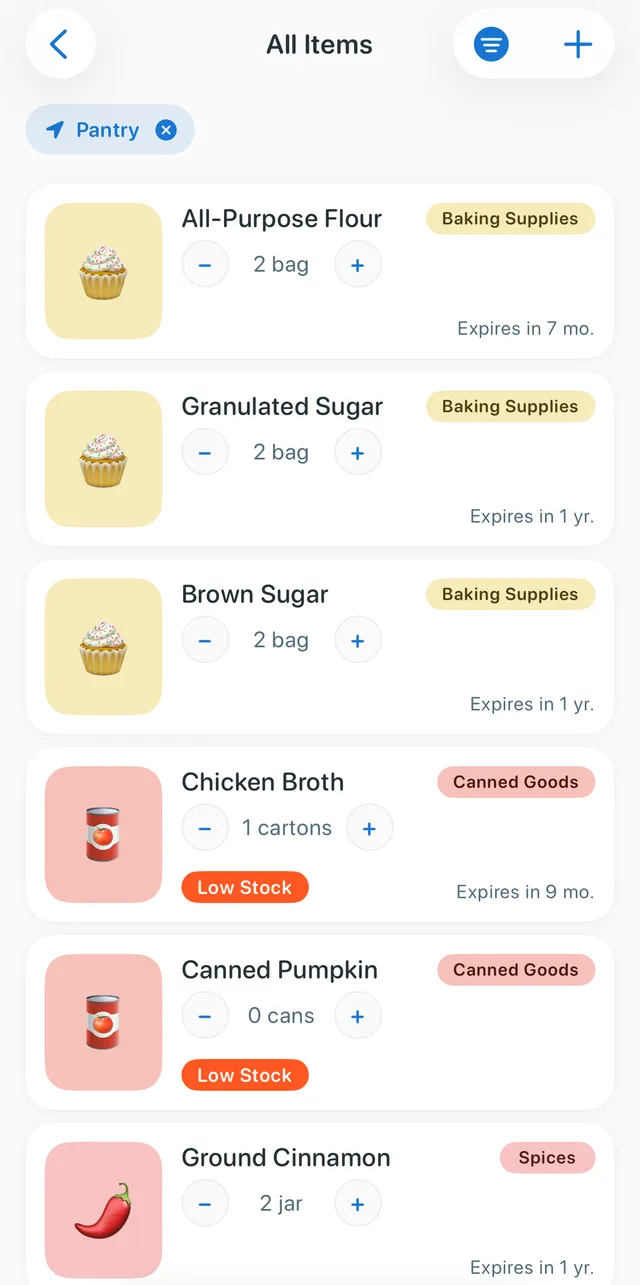
- Check your stock from anywhere. Each item has a quantity and a location. Filter your items to the Pantry and you can see whether there's flour, sugar and cinnamon without opening a cupboard, including from the baking aisle.
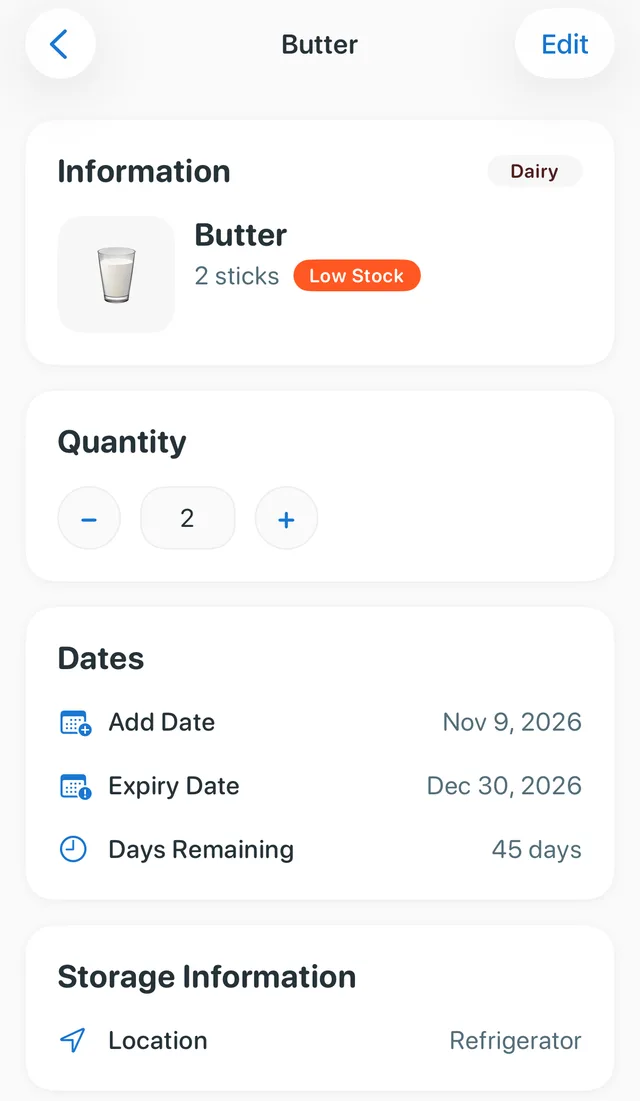
- See what's running low. Give butter, broth and flour a Low Stock Threshold. When the quantity reaches it, Panzy labels the item Low Stock. An item you've used up stays in the list at 0, so you can see it's gone.
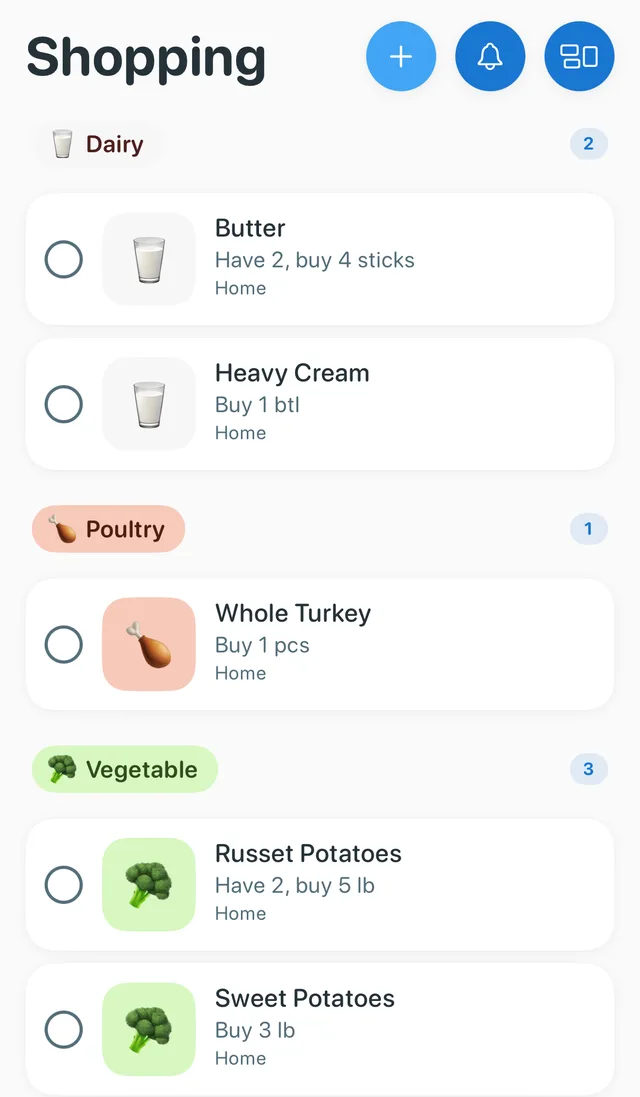
- Build the list by store section. Add an item to the shopping list from its own screen and it keeps its category. Group the list by category and it reads like the store: dairy together, vegetables together, cans together. Each entry shows how many you have next to how many to buy.
- Or group it by shop. If the turkey comes from a warehouse store and the herbs from the supermarket, set a shop on each entry and group by shop instead, one section per stop.
If someone else is doing part of the shopping, you can invite them to your pantry with their User ID so you're both looking at the same stock.
The free version covers up to 50 items and 3 shops, with ads, which is enough for the holiday staples. Panzy+ adds unlimited items and shops, the automatic shopping list, expiration reminders, iCloud sync across your Apple devices, and no ads.

Panzy: pantry tracker
Track what's in your pantry, fridge and freezer, see what is expiring soon, and keep a shopping list that knows what you're low on. Free for up to 50 items.

Common questions
How big a turkey do I need for 10 people?
About 10 pounds. The USDA's rule is 1 pound of whole turkey per person, or 1¼ pounds for a frozen pre-stuffed turkey. Buy a few pounds more if you want leftovers.
When should I buy my Thanksgiving turkey?
A frozen turkey can be bought any time, since FSIS says it keeps indefinitely in the freezer. Just leave enough days to thaw it. A fresh turkey should be bought 1 to 2 days before cooking, so the Tuesday or Wednesday before Thanksgiving, unless its tag shows a date that reaches the holiday.
When should I start thawing the turkey?
Allow about 24 hours in the fridge for every 4 to 5 pounds, according to FSIS. For Thursday dinner, a 12-pound turkey should move to the fridge by Monday, a 16-pound turkey by Sunday and a 20-pound turkey by Saturday.
How early can I do my Thanksgiving grocery shopping?
Shelf-stable and frozen food can be bought weeks ahead, along with potatoes, onions and fresh cranberries. Leave carrots, celery, cream and herbs for the weekend before, and green beans, rolls and a fresh turkey for the last day or two.
What do people usually forget to check before shopping?
The things that live at the back of a cupboard: spices, cornstarch, vanilla, broth and brown sugar. Check them before you shop, and check the butter count too, since nearly every dish on the table uses some.